
Awareness
Masterclass
Working sessionA practical 90-minute working session for operators who need a clear AI starting point.
Open this stepNo one should buy an AI build from a cold landing page. The ladder makes the operational case first.
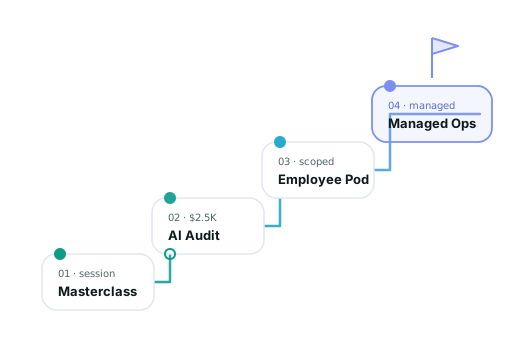
Awareness
A practical 90-minute working session for operators who need a clear AI starting point.
Open this stepDiagnosis
We map workflows, score opportunities, and return a prioritized implementation roadmap.
Open this stepBuild
A scoped AI employee for one or more real workflows, deployed with human approval and monitoring.
Open this stepOperate
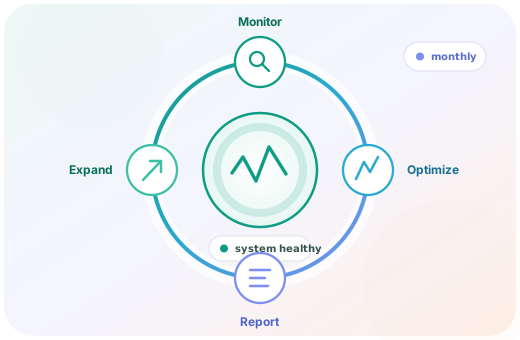
Monthly optimization, issue review, prompt/context updates, reporting, and expansion planning.
Open this stepIn 14 days, Epoches maps operational workflows, interviews the team, reviews the tool stack, scores the top automation opportunities, and returns an implementation sequence with risk notes.
Money-back guarantee if no meaningful automation opportunity is found and the client provided access.
View the audit pageEach build starts only after signed scope: owner, trigger, inputs, outputs, tools, approval gates, exclusions, evaluation criteria, timeline, and price.
One bounded workflow
2-3 connected workflows
Multi-team operations
The durable value is not the first automation. It is monitored operation: errors reviewed, context kept fresh, prompts improved, edge cases handled, and the next workflow identified.

One live AI employee
Monitoring, bug fixes, monthly review, and basic context updates.2-3 AI employees
Prompt/context improvements, reporting, support, and workflow tuning.Continuous rollout
New automations, priority support, quarterly roadmap, and expansion planning.Epoches starts where AI can reduce repetitive work without pretending to replace business judgment.
Client intake, research, drafting, CRM follow-up, reporting.
Document-heavy work with repeated review loops.Scheduling support, intake, insurance paperwork, billing admin.
Administrative only. No autonomous clinical decisions.Support triage, order operations, inventory updates, weekly reporting.
High-volume operational work across customer and stock systems.Dispatch updates, exception routing, status reporting, invoice checks.
Coordination-heavy teams with repeatable escalation rules.Document intake, summarization, checklist review, client follow-up.
Sensitive work that needs approvals, logs, and clear boundaries.Also served, outside the core focus: Real estate, Education and EdTech, Manufacturing, Hospitality and food service, Home and field services, Marketplaces, Automotive retail and service, Travel and tourism. If your sector is not listed, the audit is still the honest way to find out whether we can help.
 Governance baked in
Epoches does not ship vague demos or unsupervised agents. The delivery lifecycle is audit, scope, design, build, test, deploy, train, monitor, optimize, expand.
The audit gives you a ranked automation roadmap before committing to a build.